
Physio for knee pain Aldinga
Assessment and rehabilitation for knee pain and injury
We help identify what may be contributing to your knee pain and build the movement, strength and capacity needed for everyday life, work and sport.
HICAPS rebates
30-minutes one-on-one
AHPRA-registered
What is physiotherapy for knee pain?
Physiotherapy for knee pain begins with understanding which structures may be involved and what is contributing to the way the knee is moving and responding to load.
The knee is more complex than a simple hinge. It includes the tibiofemoral joint, where the thigh bone meets the shin bone; the patellofemoral joint, where the kneecap moves over the front of the thigh bone; and the superior tibiofibular joint on the outer side of the knee.
Because the knee is designed more for mobility than bony stability, it relies heavily on ligaments, tendons, cartilage and surrounding muscles to guide movement and manage force.
Pain can develop after an acute injury such as a twist, fall, collision or awkward landing. It can also build more gradually when repeated loading exceeds the current capacity of the tissues, when movement or strength factors influence how load travels through the lower limb, or through degenerative changes such as osteoarthritis.
Symptoms may include a diffuse ache, sharp pain, swelling, stiffness, clicking, locking or a feeling that the knee may give way.
Our physio for knee pain service focuses on understanding the likely source of the problem and matching treatment and rehabilitation to the individual presentation.
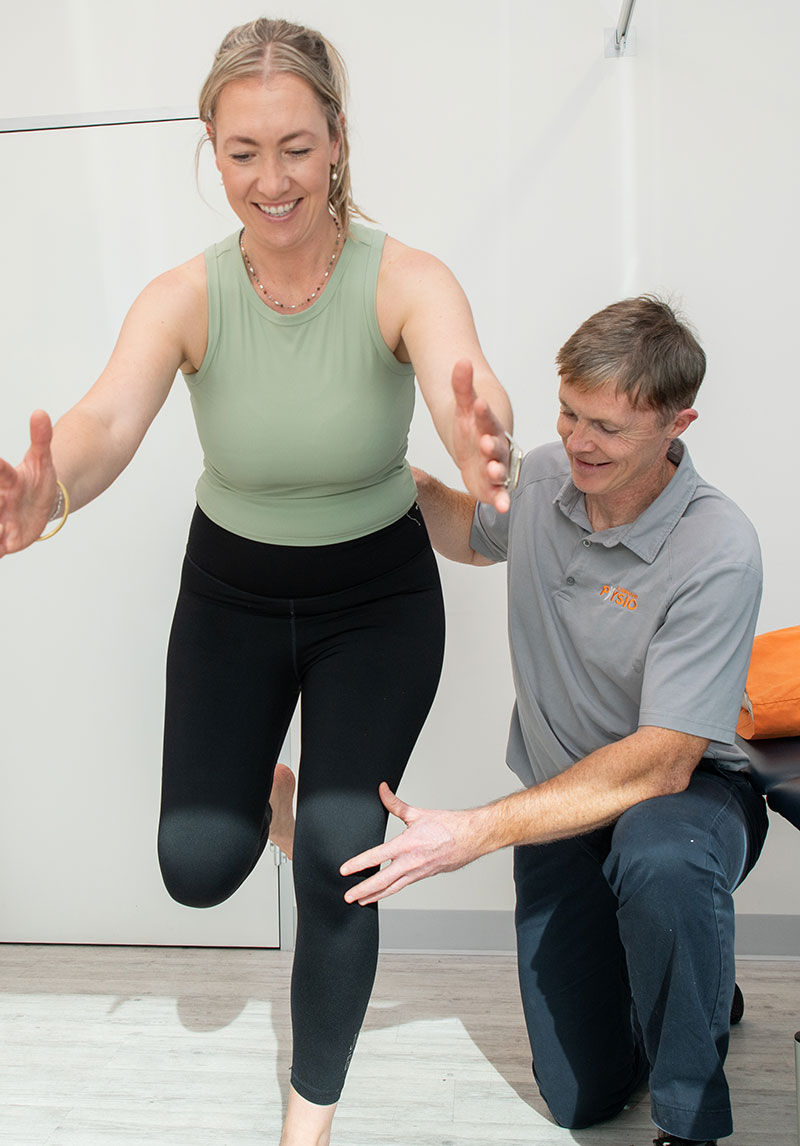
Knee pain physiotherapy assessment and treatment
Knee pain is not one condition.
Several structures sit very close together, and different problems can feel surprisingly similar. This is particularly common around the front of the knee.
Patellofemoral pain is one possibility, but symptoms in a similar area may also come from the patellar tendon, quadriceps tendon, infrapatellar fat pad, surrounding bursae or structures involved in kneecap stability.
The same applies around the outer side of the knee. Pain there may be linked to the iliotibial band, biceps femoris tendon or a ligament injury.
This distinction matters because two conditions may hurt in almost the same place but require different management.
Acute injuries can also involve the anterior cruciate ligament (ACL), posterior cruciate ligament (PCL), medial collateral ligament (MCL), lateral collateral ligament (LCL), meniscus or patella.
Rather than treating the painful area alone, assessment looks at how the problem started, how symptoms behave and which structures are most likely contributing.
Physio for knee pain
What knee pain physiotherapy may include
Treatment and rehabilitation depend on what we find during the assessment, the type of knee problem and the level of activity you need to return to.

Knee pain and injury assessment
The history behind the pain often provides some of the most useful clues.
If there has been an acute injury, we look at how the knee was loaded, twisted or compressed, the direction of force, where swelling developed and how the symptoms have changed since.
Clicking, locking, instability or giving way can also help narrow down the structures involved.
For gradual-onset knee pain, we look for changes in activity, repetition or training load that may have exceeded what the tissues were ready to manage.

Whole lower limb assessment
A painful knee does not always mean the knee is the only part of the problem.
For more biomechanical presentations, we may assess the whole kinetic chain, including the hip, knee, ankle and foot.
Strength, muscle length, joint mobility, alignment and movement control can all influence how load is distributed through the lower limb.
The aim is to identify the factors that are most relevant to your presentation, rather than assume everyone with knee pain needs the same exercises.

Manual therapy and mobilisation with movement
Manual therapy may be used where appropriate to help with pain or movement restrictions.
We also draw on Mulligan Mobilisation with Movement techniques, which combine movement with a manual glide to help address restrictions at the knee and, where relevant, the ankle or hip.

Taping and temporary offloading
Rigid or kinesiology taping may sometimes be useful, particularly with anterior knee pain.
Taping may help temporarily reduce pressure on a sensitive structure or assist movement while strength, control and load tolerance are being rebuilt.

Progressive exercise rehabilitation
Exercise is an important part of most knee rehabilitation programs.
The goal is not only to regain basic movement but to prepare the lower limb for the greatest demands it will need to handle.
For everyday life, that may mean repeated stair use, squatting, kneeling or pivoting.
For sport, rehabilitation may progress towards running, jumping, landing, cutting and changing direction at the volume and intensity required for the activity.

Return to activity and sport
Rehabilitation is built around what you need your knee to do.
That may be walking comfortably, managing physical work, returning to the gym or getting back to football, netball, running or another sport.
People managing a broader sporting injury can also find more information on sports injury physiotherapy.
Who physio for knee pain may help
Physio for knee pain may be suitable for people with a recent injury, gradual-onset symptoms, recurring knee pain or degenerative changes.
Common presentations we assess include ligament and meniscal injuries, patellofemoral pain, patellar and quadriceps tendinopathy, fat pad irritation, bursitis, iliotibial band friction syndrome and knee osteoarthritis.
Growing children and adolescents can experience different types of knee pain.
Osgood-Schlatter disease can affect the attachment area below the kneecap, while Sinding-Larsen-Johansson syndrome can cause pain at the lower pole of the patella. These are growth-related conditions that often require careful load management while the young person continues to grow and stay active.
Some people come to physiotherapy because a knee problem is keeping them away from sport. Others simply want to use stairs, kneel, garden, walk or work more comfortably.
People recovering after surgery may require a different rehabilitation pathway. See post-operative physiotherapy for information about rehabilitation following procedures such as knee replacement, arthroscopy, ACL reconstruction or meniscal repair.
The impact knee pain can have on everyday life
Knee pain often shows up most during ordinary movements.
Going down stairs, rising from a chair, getting in and out of the car, kneeling, squatting or walking longer distances can all become uncomfortable when the knee is painful, stiff or swollen.
For someone active, the limitation may only appear when the demands increase.
A knee might cope well with walking but become painful during running. Another may feel comfortable in day-to-day activity but struggle with repeated kneeling at work or the jumping and change-of-direction demands of sport.
This is why rehabilitation needs to reflect more than the basic movement you can currently tolerate.
The goal is to progressively build enough strength, movement control and physical capacity for the activities you actually need to do.
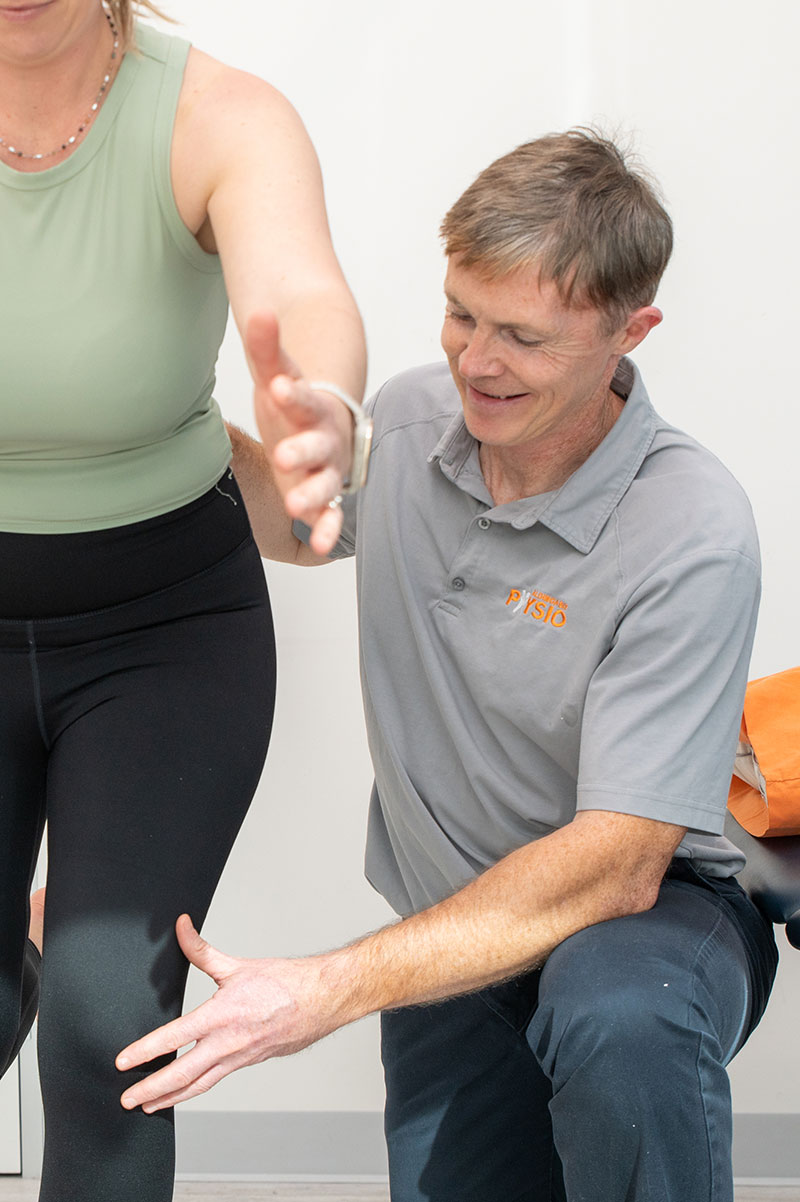
Understanding the causes of knee pain
Knee pain can broadly develop through acute injury, gradual biomechanical overload or degenerative change.
Acute injuries may affect the cruciate or collateral ligaments, meniscus, patella, tendons or other structures around the joint.
A knee can be strained or compressed during a fall, twisted under load during sport, or injured during a sudden change of direction.
Gradual-onset pain can look very different.
Anterior knee pain, for example, may develop because of changes in muscle strength or length, repeated loading, movement patterns or structural factors around the kneecap.
Possible sources include patellofemoral pain, patellar or quadriceps tendinopathy, fat pad impingement, pre-patellar or infrapatellar bursitis, synovial plica and patellofemoral instability.
Pain on the outside of the knee may instead involve structures such as the iliotibial band or biceps femoris tendon.
Degenerative changes such as osteoarthritis can affect the tibiofemoral joint, patellofemoral joint or both.
One of the reasons assessment matters is that similar symptoms can come from very different tissues.
Patellar tendinopathy can resemble fat pad impingement. Pain around the lateral collateral ligament can sit close to iliotibial band symptoms. The pain may be nearby, but the appropriate management is not necessarily the same.
How physiotherapy for knee pain is delivered
Knee assessment starts by working out how the symptoms developed and which structures are most likely to be involved. We look at the mechanism of injury or change in activity, the location of pain and swelling, movements that reproduce symptoms, and any clicking, locking or episodes of giving way.
The knee is then assessed as part of the wider lower limb. Hip control, knee strength, ankle and foot mechanics, movement patterns and the physical demands of work, sport or everyday activity may all be relevant.
The assessment may include:
- How and when the knee pain began
- Recent changes in activity or training load
- Pain and swelling location
- Knee range of movement
- Clicking, locking or instability
- Ligament or meniscal testing where appropriate
- Palpation of relevant structures
- Hip, knee, ankle and foot movement
- Lower limb strength and muscle length
- Movements relevant to work, everyday life or sport
Early management of an acute injury may focus on settling inflammation, restoring range of motion and helping you return to basic functions such as normal walking.
If the presentation suggests further investigation may be needed, we can discuss imaging or referral to another health professional such as a sports physician, orthopaedic specialist or podiatrist.
From there, rehabilitation is progressed towards restoring strength, movement and the capacity needed for your normal activities.
Good to know
Common questions about knee pain
Who provides physio for knee pain in Aldinga?
Aldinga Bay Physio provides assessment and rehabilitation for acute, gradual-onset and degenerative knee problems in Aldinga.
Treatment is based on the structures involved, the way the problem developed and the physical demands you need to return to.
How does knee pain physiotherapy work?
Knee pain physiotherapy starts with understanding the likely source of symptoms and the factors contributing to them.
Treatment may include manual therapy, mobilisation with movement, taping, strengthening, movement retraining, load management and progressive return to activity.
What affects the cost of physiotherapy for knee pain?
The cost can vary depending on consultation length, assessment complexity and rehabilitation requirements.
The number of sessions also varies according to the type of knee problem, how long symptoms have been present and the activities you are working towards.

Your local physiotherapist
Areas we service for knee pain physiotherapy
Aldinga Bay Physio provides physio for knee pain across Aldinga and surrounding southern areas including Aldinga Beach, Port Willunga, Sellicks Beach, Willunga, McLaren Vale, Seaford and Maslin Beach.
Port Willunga
Sellicks Beach
Willunga
McLaren Vale
Seaford
Maslin Beach
Locally, we see knee injuries associated with football and netball across the Southern and Great Southern leagues, as well as runners preparing for and recovering from events across the Fleurieu region.
Why choose us
Why choose Aldinga Bay Physio for knee pain treatment
Focus on identifying what is actually involved
Different tissues can produce symptoms in very similar locations.
We use the history, symptom behaviour and physical assessment to work out which structures and contributing factors are most relevant.
Looking at the whole lower limb
Biomechanical knee problems may involve more than the knee.
Assessment can include the hip, ankle and foot to understand how the lower limb manages movement and load as a whole.
Rehabilitation matched to real demands
Exercise is progressed towards what you need to do in daily life, work or sport.
That may mean stairs and kneeling for one person, or running, jumping and change of direction for another.
Acute and longer-term knee presentations
We see a broad range of knee problems, from recent ligament, meniscal and sporting injuries to tendinopathies, biomechanical overload and osteoarthritis.
Evidence-informed osteoarthritis rehabilitation
For degenerative knee conditions, we draw on principles from the GLA:D approach while adapting the exercise and loading program to the individual.
People preparing for or recovering after surgery can find more information on post-operative physiotherapy.
Education and long term management
We explain assessment findings clearly and help people better understand movement, loading, conditioning, and factors linked to recurrence.
FAQs
Frequently asked questions about physiotherapy for knee pain
What types of knee pain can physiotherapy assess?
Physiotherapy may be appropriate for ligament and meniscal injuries, anterior knee pain, patellofemoral pain, tendon problems, iliotibial band irritation, bursitis, osteoarthritis and other musculoskeletal knee conditions.
Symptoms may include pain, swelling, stiffness, reduced movement, clicking, locking or giving way.
Why does identifying the source of knee pain matter?
Different structures can hurt in almost the same place.
Patellar tendinopathy and fat pad impingement are one example, while lateral collateral ligament problems and iliotibial band friction syndrome may both cause pain around the outside of the knee.
Because their management can differ, identifying what is most likely involved helps guide rehabilitation more specifically.
Do I need an MRI or X-ray before seeing a physiotherapist?
Not everyone with knee pain requires imaging before physiotherapy.
Assessment considers how the problem developed, symptoms, swelling, movement and the structures that may be involved. If further investigation appears appropriate, imaging or onward referral can be discussed.
Can physiotherapy help with knee osteoarthritis?
Physiotherapy can form part of conservative management for knee osteoarthritis.
Rehabilitation may focus on strength, movement and building capacity for everyday activity, with loading adjusted to the individual.
Can physiotherapy help me return to sport after a knee injury?
Rehabilitation can be progressed towards the specific demands of your sport.
This may include lower limb strengthening followed by jumping, landing, cutting, changing direction and a gradual return to training.
See sports injury physiotherapy for more information.
How many physiotherapy sessions are needed for knee pain?
The number of sessions varies according to the structure involved, severity and duration of symptoms, physical conditioning and the level of activity you need to return to.
Progress is reviewed throughout rehabilitation and treatment adjusted according to how the knee responds.
Book a knee pain physiotherapy appointment in Aldinga
If knee pain, swelling, stiffness, instability or injury is affecting your everyday activity, work or sport, contact Aldinga Bay Physio to arrange an assessment.
We can assess the knee, look at contributing factors throughout the lower limb and build a rehabilitation approach around the activities you need to return to.
Book your appointment online or call us directly.