
How migraine physiotherapy can help when neck symptoms are involved
If there is one thing I have learnt from treating people with migraine and headache symptoms, it is that the neck can be relevant without being the whole explanation.
Migraine is a neurological condition, and its triggers can include genetics, hormones, stress, sleep, food and environmental factors. But some people also experience neck stiffness, shoulder tension, cervical sensitivity or dizziness around the time of their attacks.
That is where migraine physiotherapy can have a role. The aim is not to treat migraine as a neck problem, but to identify physical factors that may be contributing to the overall symptom picture.
Migraine and cervicogenic headache are not the same thing
A migraine is neurological. It may involve throbbing or pulsing head pain, nausea, vomiting, sensitivity to light, sound or smells, and sometimes aura.
A cervicogenic headache is different. It is a secondary headache where pain felt in the head originates from another structure, most commonly the upper neck and sometimes the jaw.
Cervicogenic headache is more likely to feel like a steady ache around the base of the skull, temple or behind the eye and may be aggravated by neck movement or sustained positions.
The complication is that symptoms can overlap. Someone with migraine may also have neck stiffness or muscle tension, while someone with a cervicogenic headache may initially assume their symptoms are migraine.
In practice, the label alone does not always tell us enough. Our clinic Aldinga Bay Physio looks at the pattern of symptoms and the physical factors that may be contributing, rather than assuming every headache should be managed in the same way.
Factors that can influence migraine symptoms
Migraine does not usually have one simple trigger. Several neurological, physical, lifestyle and environmental factors can influence when symptoms appear and how an episode behaves.
Genetics and neurological factors
Migraine often runs in families. The exact neurological mechanisms are complex, but changes in brain chemistry and electrical activity are thought to play a role in how migraine attacks develop.
Hormonal changes
Changes in hormones, particularly fluctuations in oestrogen, can influence migraine symptoms for some people. Menstrual cycles and changes in oral contraceptives are examples identified in the client material.
Physical and emotional stress
Both forms of stress can matter. Emotional stress, anxiety or a significant shock may coincide with migraine attacks, while heavy physical exertion can also contribute for some people.
Sleep and meal patterns
Poor sleep and skipped meals are common factors worth considering when looking for patterns around migraine onset. Small disruptions can sometimes become more important when they occur alongside other triggers.
Light, sound and environmental stimuli
Bright or flashing lights, loud sounds, strong smells and changes in weather can act as triggers for some people. These sensitivities also commonly form part of the migraine itself.
Food and drink
Certain foods or drinks may be relevant for individual patients. The client material identifies caffeine, alcohol, artificial additives and some aged foods as examples.
Neck and shoulder tension
Some people with migraine also develop stiffness or muscle tension through the neck and shoulders. This does not mean the neck caused the migraine, but it may add to the overall symptom burden and provide a physical factor that physiotherapy can assess.
Dizziness and vestibular symptoms
Migraine can also be associated with dizziness, vertigo or motion sensitivity. Where these symptoms are present, vestibular assessment and exercise may form part of the physiotherapy approach.
A familiar headache can sometimes be reproduced from the neck
One thing I find particularly useful when assessing headaches is trying to reproduce the person’s familiar pain and track down the mechanical structure that appears to be driving it.
In cervicogenic headache, that may be an upper cervical facet joint such as C2/C3. If controlled pressure or movement through that joint reproduces the recognised headache, it gives us a much clearer indication that the joint is contributing.
In other presentations, the main finding may be muscular rather than joint-related.
The important part is not simply finding something that feels tight. It is working out which structure is most relevant and then addressing the factors that may be keeping it irritated.
Other factors can add to the migraine picture
Migraine rarely comes down to one simple factor.
Stress, poor sleep, skipped meals, hormonal changes, certain foods, bright lights, strong smells and environmental changes may all influence when symptoms appear.
Physical factors can sit alongside these.
Long periods at a screen, neck and shoulder tension, reduced movement or an unusually demanding period of work or exercise may increase the overall physical load.
In practice, I find it useful to look at what tends to be happening around the onset of a person’s migraine rather than searching for one universal trigger.
Modern routines can increase physical load
Often, when I look more closely at a person’s daily routine, the reason for repeated muscle overactivity becomes clearer.
Long periods at a poorly arranged workstation, a persistent forward head position or rounded shoulders can keep the neck and upper-back muscles working in less efficient positions.
Treatment can then move beyond simply releasing those muscles. We can look at workstation setup, postural awareness and strengthening so the person is better able to maintain a more comfortable position throughout the day. For a broader explanation of how work habits, screens and movement can affect the cervical spine, read why neck pain is often more complex than a posture problem.
Migraine symptoms can extend beyond head pain
Migraine can involve much more than pain.
Some people experience nausea, visual disturbance, sensitivity to light or sound, dizziness, vertigo or motion sensitivity.
These additional symptoms can affect work, driving, exercise and everyday activity even when the headache itself is not at its worst.
Where dizziness or motion sensitivity is part of the presentation, physiotherapy may include vestibular assessment and exercise rather than focusing only on the neck.
This is another reason migraine physiotherapy needs to be based on the individual symptom pattern.
The symptom and the contributing factor are not always the same thing
Neck tension during migraine does not necessarily mean the neck caused the migraine.
Muscles can tighten in response to pain. The cervical spine may become more sensitive during an attack. In other people, mechanical stiffness or muscle overactivity may genuinely be contributing to the overall presentation.
Distinguishing between these possibilities matters.
I find it more useful to ask why a structure is sensitive or why a muscle keeps becoming overactive rather than simply treating the area that feels tight.
That may lead us towards cervical joint stiffness, workstation habits, prolonged positions, stress, reduced strength or another recurring factor.
How physiotherapy approaches migraine-related physical symptoms
Migraine-related physical symptoms rarely fit neatly into one box, so the assessment starts by working out which parts of the presentation appear to be neurological, which appear to be mechanical, and where the two may overlap.
That means looking closely at the history first: how the symptoms behave, what tends to happen before an attack, whether the neck becomes stiff or painful, and whether dizziness, movement or sustained positions influence the overall picture. This sits within our broader physiotherapy services, where treatment is guided by the factors most relevant to the individual rather than a standard protocol.
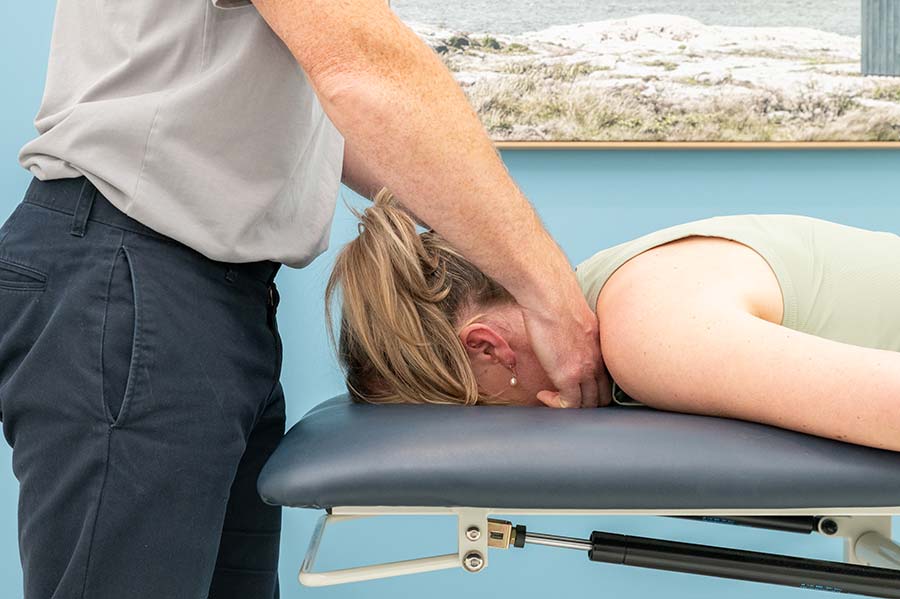
The physical assessment may then look at cervical movement, upper cervical joint sensitivity, neck and shoulder muscle tension, strength, posture and vestibular function where dizziness is present.
Anthony Sheridan has undertaken training in the principles of the Watson Headache® Approach, which places particular emphasis on the upper cervical spine and its relationship to familiar headache symptoms.
From there, treatment is selected according to what the assessment identifies. This may include Maitland mobilisation, Mulligan techniques, soft tissue therapy, dry needling, exercise or vestibular rehabilitation, with the aim of addressing the physical contributors that appear to matter most in that person’s presentation.
Management needs to go beyond short-term relief
Reducing neck tension or restoring movement can be useful, but the longer-term plan should also consider why symptoms keep recurring.
For someone spending long hours at a workstation, that may involve changing screen setup, improving movement breaks and building postural endurance.
For another person, the most useful work may involve identifying patterns around sleep, stress, meals or environmental triggers.
Exercise can also form part of the plan, particularly where neck and upper-back strength or general physical capacity need rebuilding.
The aim is not to remove every possible migraine trigger. It is to identify the factors that are both relevant and realistically modifiable.
Physiotherapy is one part of migraine management
Migraine is a neurological condition, so physiotherapy should not be presented as a replacement for broader medical management.
Its role is more specific.
Where cervical stiffness, muscle tension, dizziness, reduced movement or other physical contributors are present, physiotherapy can assess and address those factors.
For some people, that may be an important part of their overall migraine management. For others, the physical component may be relatively small.
That distinction is why assessment comes first.
Looking for patterns can make management more useful
When I work with someone who experiences migraine, I encourage them to think carefully about what tends to be happening around the onset of an attack.
Sometimes a pattern emerges around certain foods, a particularly stressful time of the week or month, poor sleep, skipped meals or environmental stimuli such as flashing lights.
The aim is not to assume every migraine has one clear trigger. It is to identify recurring factors that may be contributing and then work out which of those can realistically be modified.
Building a longer-term strategy
Some people experience migraine or headache symptoms intermittently over many years.
When physical contributors repeatedly form part of the presentation, management may involve maintaining cervical mobility, improving strength and endurance, reviewing work habits and responding earlier when familiar physical signs begin to build.
The aim is not to promise that migraine will never return.
It is to improve control over the factors that can reasonably be changed and reduce the physical burden around recurring episodes.
For some people, periodic physiotherapy review may also be useful when neck stiffness or muscle tension repeatedly accompanies their headaches.
Migraine physiotherapy in Aldinga
Aldinga Bay Physio provides physiotherapy assessment for people experiencing migraine-related neck symptoms, cervicogenic headaches, upper cervical stiffness, muscle tension and dizziness.
If you are unsure if the neck or other physical factors may be contributing to your headache pattern, an assessment can help identify what is relevant and where physiotherapy may fit within your broader management.
You can also read more about physio for headaches in Aldinga and physio for neck pain.