
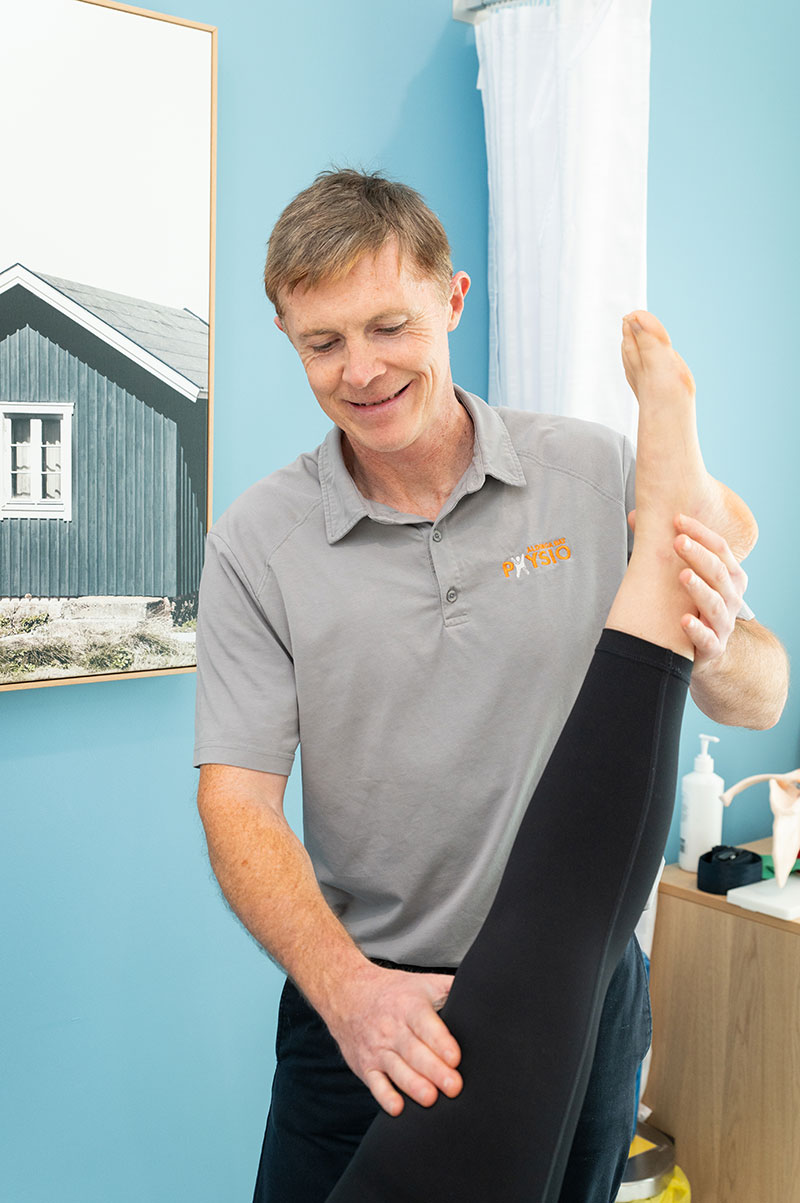
Sciatic nerve pain: why the source of your symptoms matters
Sciatic nerve pain is often described as pain that travels from the lower back or buttock into the leg. It may feel like a deep ache, burning, tingling, numbness or an electric sensation extending into the calf or foot.
But that description does not tell us exactly what is causing it.
Sciatica is a pattern of symptoms rather than one specific injury, and similar symptoms can arise for different reasons. A nerve root may be irritated in the lower back, the sciatic nerve may be affected further along its pathway, or pain from another structure may be referring into the buttock or thigh without the nerve itself being directly involved.
That distinction matters because sciatic nerve pain management should be based on the mechanism behind the symptoms rather than simply the location of the pain.
This is where physiotherapy assessment becomes particularly important.
Sciatic nerve pain does not always start where you feel it
The sciatic nerve is formed from nerve roots in the lower spine before travelling through the buttock and down the back of the leg towards the foot.
When one of those nerve roots becomes irritated, symptoms can be experienced a considerable distance from the lower back.
Someone may therefore feel most of their pain in the hamstring, calf or even further down the leg while having relatively little back pain.
This is one of the reasons sciatica can sometimes be confusing.
The place that hurts is not necessarily the place where the main problem originates.
A local calf problem and nerve pain travelling into the calf may feel similar at first. The same applies around the hamstring, buttock and hip.
Understanding that relationship helps explain why simply treating the sore part of the leg does not always address the problem.
Pain down the leg is not automatically sciatica
Not all pain travelling away from the lower back involves the sciatic nerve.
Structures such as lumbar facet joints, ligaments and the sacroiliac region can refer pain into the buttock or upper thigh without direct nerve-root involvement.
This is sometimes described as somatic referred pain.
True radicular or sciatic nerve symptoms more directly involve irritation or compression of a nerve root or the nerve pathway itself. These symptoms may follow a more recognisable neural distribution and can sometimes be accompanied by altered sensation, changes in reflexes or localised weakness.
There is another group of presentations where irritation may occur further along the nerve rather than at the spine. The deep gluteal region is one example, including presentations sometimes described as piriformis syndrome or deep gluteal syndrome.
These problems can overlap in how they feel.
The challenge is therefore not simply deciding, “Is there pain down the leg?” It is working out what structure is producing it and how the symptoms behave.
Sciatica can look like a hamstring, calf or hip injury
One thing I regularly see in practice is someone arriving convinced they have injured a muscle somewhere in the leg when the assessment starts to point towards neural involvement.
The suspected injury might be the hamstring, calf or hip. Symptoms further down the leg can also be interpreted as a local foot or Achilles problem.
The confusion is understandable.
Both muscle and nerve problems can produce aching, tightness and pain with movement. But the history and symptom behaviour can be quite different.
A local muscle injury is usually associated with direct tissue overload, impact or a recognisable movement that stresses that particular muscle.
Neural symptoms may feel more like burning, electric pain, aching or unusual tightness along a pathway. They may also behave differently when the spine or nerve is placed in certain positions.
This is why repeatedly stretching an area that feels “tight” does not necessarily help if the apparent hamstring or calf tightness is actually part of an irritable neural presentation.
Where can sciatic nerve pain come from?
Several different mechanisms can produce symptoms associated with sciatica.
Disc-related nerve root irritation
Disc-related problems are one source of acute radicular symptoms.
The discs between the vertebrae can become strained, protrude or prolapse. At levels such as L4/L5 or L5/S1, disc material or associated inflammatory irritation may affect an adjacent nerve root.
This can produce pain that travels through the buttock and leg rather than remaining confined to the lower back.
Foraminal narrowing and degenerative change
For other people, symptoms develop more gradually.
The intervertebral foramina are openings through which spinal nerve roots leave the spine. Age-related changes including reduced disc height, facet joint enlargement and osteophytes can reduce the available space around a nerve.
Symptoms in these presentations may behave differently according to standing, walking, spinal extension or other loading positions.
Deep gluteal nerve irritation
The sciatic nerve also passes through the deep buttock region.
Irritation, compression or reduced mobility around this area can produce symptoms down the leg without the main source being a lumbar nerve root.
Spondylolisthesis
Spondylolisthesis involves one vertebra moving forward relative to the vertebra below.
In some presentations this can influence the space around an exiting nerve root and contribute to leg symptoms that vary with loading and position.
The key point is that the word “sciatica” alone does not tell us which of these mechanisms is involved.
How physiotherapy helps identify the source of sciatic nerve pain
A useful sciatica physiotherapy assessment is not based only on asking where it hurts.
We want to understand how the symptoms began, where they travel and what changes them.
Did symptoms begin after lifting or bending? Have they gradually developed alongside prolonged sitting or standing? Does walking help or aggravate them? Do particular spinal movements move the symptoms further down the leg or bring them closer towards the back?
Neurological screening may also be relevant.
This can include checking sensation, reflexes and muscle strength where appropriate.
Neurodynamic testing provides further information about how sensitive the involved neural structures are to movement.
The hip and deep gluteal region may also need to be assessed if the presentation suggests irritation further along the sciatic nerve pathway.
In practice, the goal is to build several pieces of information together rather than relying on one test or one symptom.
Why symptom response to movement can tell us something useful
Sciatic nerve symptoms do not always respond to movement in the same way.
In some disc-related presentations, certain repeated movements or positions can reduce symptoms further down the leg.
A person may begin with pain extending into the calf, for example, and notice that a particular movement causes the calf symptoms to reduce while discomfort becomes more concentrated towards the buttock or lower back.
This pattern is commonly referred to as centralisation.
Other movements may have the opposite effect and increase symptoms further down the leg.
Identifying a directional preference can therefore help guide activity and exercise choices for some people.
This does not mean the same exercise should be prescribed for everybody with sciatica.
A movement that helps one presentation may be inappropriate for another, which is another reason physiotherapy assessment needs to come before assuming which exercise or direction is best.
Stretching is not always the answer for sciatic nerve pain
When the back of the leg feels tight, stretching can seem like the obvious response.
But nerves and muscles do not behave in exactly the same way.
An irritated nerve root can become particularly sensitive to stretch. Aggressively pulling on an already sensitive neural structure may therefore provoke symptoms rather than settle them.
Physiotherapy may instead use neurodynamic sliders or gliding movements.
These are controlled movements intended to help the nerve move through surrounding tissues without applying a strong sustained stretch.
The amount and type of movement depend on how irritable the presentation is.
As sensitivity settles, ordinary movements such as bending, reaching and walking can also be progressively reintroduced.
Physiotherapy treatment depends on the presentation
There is no single technique that defines physio for sciatic nerve pain.
Treatment may differ considerably depending on where the symptoms appear to originate and what the assessment identifies.
For some people, early management may focus on positions and movements that reduce leg symptoms.
Manual therapy may be used where joint stiffness or surrounding muscle guarding appears relevant. The supplied treatment approach includes Maitland lumbar mobilisation and Mulligan Mobilisation with Movement where appropriate.
Soft tissue techniques or dry needling may be considered when muscular guarding around the lumbar or deep gluteal region is part of the presentation.
Neurodynamic techniques can address nerve mobility and sensitivity.
Exercise rehabilitation then becomes increasingly important as symptoms settle, with attention to lumbar and pelvic control, hip function, lower-limb movement and physical capacity.
The purpose is not to use every treatment on every patient.
It is to identify which elements are most relevant to the particular presentation.
Sitting, driving and sudden increases in load can matter
Sciatic symptoms can also be influenced by what has been happening around the time they begin.
Prolonged sitting and driving are common examples in the supplied clinical material.
Extended sitting places sustained load through the lumbar region and can also maintain pressure around the deep gluteal area.
Sudden increases in bending or lifting can create a very different type of load.
Heavy manual work, awkward lifting, dynamic yard work or gym activity involving substantial loading and rotation may coincide with acute disc or nerve-root symptoms in some people.
I also see a recognisable pattern around periods of heavier gardening.
A few hours of repeated bending, stooping, weeding and shovelling can be a substantial change in load for someone whose usual week involves much less of that movement.
It is often not that gardening itself is the problem. The issue is the size and duration of the load compared with what the body has recently been accustomed to.
Sciatic nerve pain affects different age groups differently
Sciatica is not limited to older adults.
In day-to-day practice, the most common age group described in the supplied clinical material is roughly 40 to 70, where age-related disc, facet and foraminal changes may combine with normal daily loading.
But younger adults can also experience intense sciatic symptoms.
For people in their 20s and 30s, presentations may appear after heavy lifting, sporting activity or other sudden changes in mechanical load.
The mechanism therefore matters more than simply the person's age.
Two people with pain travelling down the same part of the leg may have quite different underlying presentations and require different rehabilitation priorities.
Sciatic nerve pain management should progress beyond symptom relief
During an acute episode, reducing highly irritable symptoms understandably becomes the immediate priority.
But longer-term sciatic nerve pain management may need to go further.
Once the nerve becomes less sensitive, rehabilitation can gradually restore normal movement and build tolerance for the activities that matter to the person.
That may include sitting through a workday, driving longer distances, returning to manual work, gardening, gym training or playing sport.
Strength and movement control through the lumbar spine, pelvis, hips and lower limbs may form part of that progression where they are relevant.
The goal is to increase the person's capacity for their actual demands rather than simply reaching the point where symptoms are quieter during rest.
Recurrent sciatica deserves another look at the contributing factors
Some people experience more than one episode of sciatica.
When I see someone who has had similar episodes before, I am interested in more than what has irritated the nerve this time.
Has there been a recurring pattern around sudden increases in physical activity?
Is prolonged sitting repeatedly involved?
Has physical conditioning changed?
Are there particular movements or workloads that consistently precede an episode?
The supplied clinical approach places emphasis on looking at movement control, changes in load and lumbopelvic capacity when recurrent symptoms become a pattern.
That does not mean every recurrence has exactly the same cause, but it can help shape a broader rehabilitation strategy rather than treating each episode in isolation.
When physiotherapy is only one part of sciatica management
Some sciatic nerve presentations are highly irritable or severe enough that physiotherapy may need to sit within broader medical care.
The supplied treatment approach includes communication with a General Practitioner or specialist when symptoms are not settling adequately with physiotherapy alone.
In some cases, a medical specialist may consider interventions such as a lumbar epidural or nerve-root corticosteroid injection.
That decision belongs within medical assessment and management.
From a physiotherapy perspective, collaboration can be useful when another form of medical treatment is required before rehabilitation can progress comfortably.
The source of sciatic nerve pain changes what we do next
The phrase sciatic nerve pain describes an important symptom pattern, but it is still only the beginning of the clinical picture.
Pain may relate to nerve-root irritation from a disc problem, narrowing around the exiting nerve, irritation further along the sciatic nerve pathway or another structure referring pain into the leg.
And sometimes the person who thinks they have sciatica has a different musculoskeletal problem altogether.
That is why physiotherapy assessment focuses on the history, neurological findings, movement response, nerve sensitivity and physical demands around the individual presentation.
The more accurately we understand what may be producing the symptoms, the more relevant the rehabilitation can become.
Sciatic nerve pain physiotherapy in Aldinga
Aldinga Bay Physio provides physiotherapy assessment and rehabilitation for people experiencing sciatic nerve pain, pain travelling into the leg, tingling, numbness and other symptoms associated with sciatica.
If you would like more information about assessment and treatment, visit our physio for sciatica in Aldinga page.
People whose symptoms are primarily associated with the lumbar spine can also read more about physio for back pain, while people managing symptoms around sport can find further information about physio for sports injuries.